
About us
EuroAirport - Serving the needs of the RegioTriRhena
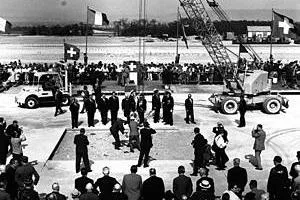
From the first stone in 1946...
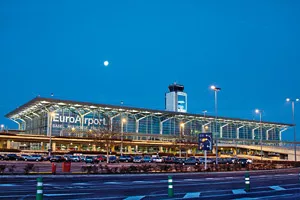
to today and tomorrow...
History of the Airport
The first infrastructure of binational Basel-Mulhouse Airport was constructed within two months and inaugurated on May 8, 1946, after the first civilian aircraft had landed there just a few days before on May 2, 1946.
Basel-Mulhouse Airport, known under its trademark EuroAirport Basel-Mulhouse-Freiburg, is a symbol for international cooperation, which became absolutely vital after the Second World War.
Plans for such a project, however, go back even further, to the 1930s, when the authorities of the Cantons of Basel-Stadt and Basel-Landschaft realised that the Basel-Sternenfeld Airfield would soon become too small due to the increase in air traffic and the use of new aircraft such as the Douglas DC-3.
At that time, the French government had given the go-ahead for a project on the border between Allschwil and Burgfelden. With the outbreak of the Second World War, however, negotiations were suspended.
They were resumed in May 1945 and eventually led to a basic agreement according to which France was to provide the land and Switzerland to build the runways and airport buildings. Without waiting for the signing of the Franco-Swiss Treaty on July 4, 1949 in Berne, the authorities decided to start construction of the first provisional infrastructure.
In the years that followed, the initial extension of the Airport was pushed forward. In 1951-52, the Swiss customs-free road connecting Basel city directly to the Airport was built. In December 1952, the 1 600-meter-long east/west runway was completed. One year later, the 2 370-meter-long main north/south runway, equipped with an instrument landing system, was commissioned. After the runways as well as air traffic control facilities and equipment had been provided, major buildings were constructed: the aircraft hangars were completed in 1966, the cargo warehouses became operational in May 1970 and on June 27, 1970 the then "finished" Airport was inaugurated.
Since then, the existing infrastructure has been systematically extended and rebuilt as needed. In 1978, the main runway was extended to 3 900 meters in order to allow unrestricted take-offs and landings for all types of aircraft. The extension of the cross runway by 220 meters followed in 2001. In 1979-81, the cargo hall including its office wing was extended. In 1988, a provisional hall for the upcoming express and courier freight was added and replaced by the final "West End" in 1996. In 2015, the former cargo hall was replaced by a modern, new Cargo Terminal in Zone 4, located in the southeast of the Airport. It meets the requirements of the local industry, particularly those of pharmaceutical companies.
In 1990, departure halls were redesigned in the Passenger Terminal and further aircraft parking positions with direct access to the terminal were created through the addition of a finger dock. In 2000-2001, this finger dock was extended to constitute the present Y-shaped finger dock with approximately 25 aircraft parking positions. In a similar way and in order to cope with the steadily increasing passenger numbers, the terminal was considerably enlarged and modernised on the landside; at the end of 2002, the extension of the French section was opened, followed by the Swiss section in the summer of 2005. The still existing, older central part of the terminal was rebuilt by early 2013 and its appearance adapted to that of the modern, more recent buildings; the refurbished Hall 2 in the French section already came into service again in the summer of 2011.
Important milestones
Éléments
-
1946 - 1969
1946 - After two months of construction, the provisional Airport is inaugurated
1949 - Franco-Swiss Treaty signed in Bern
1952 - Opening of customs-free road connecting the city of Basel to the Airport
1966 - Completion of aircraft maintenance hangars with workshops and office wing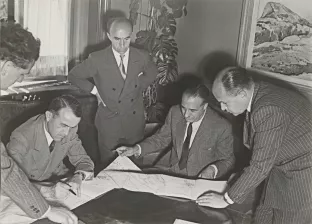
-
1970 - 1999
1970 - Inauguration of the passenger terminal with a capacity of 1 million passengers per year
1978 - Extension of the main runway to 3 900 m
1984 - The 1-million-passenger mark is passed for the first time
1987 - Launch of the EuroAirport Basel-Mulhouse-Freiburg trademark
1992 - The 2-million-passenger mark is passed for the first time
1996 - Award as Europe’s best regional airport
1998 - 3-million-passenger mark is passed for the first time
1999 - Foundation stone laid for new finger dock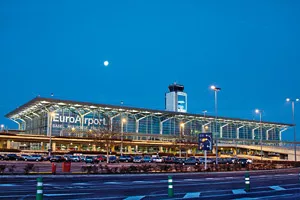
-
2000 - 2024
2002 - Inauguration of Passenger Terminal North
2005 - Inauguration of Passenger Terminal South
2006 - 4 million passengers for the first time; green light for extension of the South Zone
2008 - The Southwest Zone "6bis" (aircraft maintenance and conversion) with wide-body aircraft hangars becomes operational
2011 - 5 million passengers for the first time
2012 - Renovation of the Airport Terminal’s old section
2014 - The Airport passes the 6-million-passenger mark for the first time
2015 - 7 million passengers for the first time; inauguration of the new Cargo Terminal
2017 - Inauguration of the new F4 multi-storey parking structure with 2 700 parking spots
2018 - More than 8 million passengers for the first time
2019 - 9 million passengers for the first time
2020 - Unprecedented coronavirus crisis, traffic drops to 2.6 million passengers
2024 - The Airport welcomes almost 9 million passengers again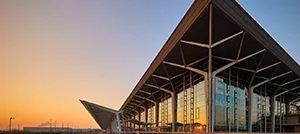
EuroAirport today
The extremely convenient location of EuroAirport at the heart of Western Europe and at the crossroads of three economically thriving regions (Alsace, Northwest Switzerland and Baden-Württemberg) explains the Airport’s success. EuroAirport is the best equipped airport in the Upper Rhine Region and, thanks to its infrastructure, can handle any type of traffic.
The Airport is a key infrastructure in the Tri-Border Area. Many important industries such as the largest European life science cluster are located in the Airport’s immediate vicinity. The airport platform itself is home to the world’s largest industrial center of competence, specialised in cabin interior customisation for VVIP* aircraft. It generates approximately one third of all jobs located directly on the airport platform.
With over 6 500 jobs, the Airport and its partner companies make a significant economic contribution to the tri-national metropolitan region. It is a major employment hub within the Trinational Region.
In 2019, passenger numbers reached 9.1 million. The flight route network included around 100 airports in more than 30 different countries, which could usually be reached directly several times a week or on a daily basis, without the need for connecting flights.
In 2020, passenger volume dropped to 2.6 million due to the global pandemic. Despite this context, EuroAirport maintained an offer of more than 80 destinations throughout Europe and the Mediterranean region. After the pandemic, travel-related traffic gradually picked up again, and in 2024, the Airport welcomed 8.9 million passengers, an increase of 10.2% compared to the previous year. Around 30 airlines offered a total of 100 destinations, primarily to Europe and the Mediterranean region.
Market leaders are easyJet and Wizz Air, followed by Pegasus, British Airways and Lufthansa. Leading international airline alliances – Star Alliance, SkyTeam and oneworld – are present at the Airport, with many airlines offering attractive connecting flights via their international hubs: Air France (Paris), Austrian Airlines (Vienna), British Airways (London), flydubai (Dubai), KLM (Amsterdam), Lufthansa (Frankfurt and Munich), Norwegian (Oslo), Pegasus Airlines and Turkish Airlines (Istanbul) as well as Vueling (Barcelona).
Basel-Mulhouse Airport plays a strategic role in cargo-related air traffic within the trinational logistics cluster. Cargo handling increased significantly during the crisis. Since then, cargo volumes have returned to pre-crisis levels: in 2024, the total cargo volume of just under 105 000 tons corresponded to 99% of the volume in 2019.
Outlook for the future
At the beginning of 2020, the Covid-19-related crisis ended a decade of growth for the sector of air transportation. Today, air traffic is gradually returning to the 2019 levels in Europe and the Mediterranean region. However, travel habits have changed. At Basel-Mulhouse Airport, travel for family reasons increased significantly, while business travel decreased.The proportion of tourism-related trips is relatively stable. The greatest challenge for air transportation in the coming decades will be decarbonisation. The reduction of night-time aircraft noise pollution is a particular concern for Basel-Mulhouse Airport, as it is located in a densely populated area.
The Airport's development is based on the principle of sustainability. The three pillars of sustainable development - economic, social and environmental - are taken into account for all the Airport’s decisions. According to the EAP 2023 strategy, there are two key focal areas: improving service quality, while also placing particular emphasis on environmental issues. The two most important priorities for action here are reducing night-time aircraft noise pollution and reducing the Airport’s carbon footprint.
The Airport decided to realise the “EMT” (Evolution Modulaire du Terminal) project. This will enable EuroAirport’s terminal infrastructure to be extended and modernised. The project is divided into several independent modules, which allow for a gradual and flexible implementation of the individual modules. The first module, “Landside”, includes an annex to the existing terminal building of around 14 000 m² on the east side, as well as the renovation of 15 000 m² in the existing terminal. Construction is scheduled to begin in 2027, with completion of the new building in 2030/31. In the meantime, the Airport will carry out an action plan to improve service quality by means of targeted measures by 2026. Some projects have already been completed (renovation of the Arrival Zone, reorganisation of the catering facilities), others are currently in their planning stage (renovation of bathroom facilities, signage, improvement of the gate areas, etc.).
After decades of flight operations, EuroAirport’s main runway is in need of refurbishment. Refurbishment work is scheduled for spring 2026. For safety reasons, it will be necessary to close the runway completely for a period of around one month.
Another important project for EuroAirport and the region is the direct railway connection (New Rail Link) to the Airport. This project was officially resumed by the French government at the beginning of 2010. Its goal is to significantly improve access to the Airport for both travellers and employees from the Alsace region and the greater Basel area. EuroAirport will actively participate in further planning work during the next phase of the project.
Another future project is the construction of a hotel with 200 rooms in close proximity to the Airport Terminal.